Monday, October 7, 2013

30 Ideas in 30 Days: #20 Temporary Improvements Encourage Historic Preservation Planning

30 Ideas in 30 Days

For the first ten days we've focused on ideas that deal with streets and public spaces. Now we are shifting gears to talk about the built environment and those things that define a space and make it welcoming to people.

Andrew Howard of Better Block. Credit: "The Better Block Project San Antonio TX," YouTube.

Idea #20: Temporary Improvements Encourage Historic Preservation Planning

This next idea comes to us compliments of Fernanda Sotelo, a recent graduate of the Columbia University M.S. in Historic Preservation program. Her graduate thesis, Beyond Temporary: Preserving the Built Environment with Temporary Urban Interventions analyzed three Better Block projects in-depth. Some recommendations of best practice were presented for how temporary interventions may prompt long-lasting gains through historic preservation.

The most important aspects of temporary urban interventions Sotelo identified were: direct public participation, long-term goals and objectives, continued activation of spaces through periodic interventions, analysis of intervention results and reassessment of long-term goals, professional guidance from a preservationist throughout the intervention, and development and adoption of a preservation plan. As Sotelo envisions it, the intervention consists of three phases: pre-planning, the event itself, then analysis and follow-up action after the initial event is done.

Sotelo has the most recommendations to provide for pre-event planning during Phase I. Among the actions she calls for is to create the project team, identify the project site, devise an intervention plan and length. Work needs to be done on outreach and collaboration, establishment of public participation methods, and beginning of work on a preservation plan during this phase. Obtaining permission from property owners and getting permits that are needed to make interventions is done. This is where her professional preservation training runs afoul somewhat with the haphazard and seemingly spontaneous nature of the Better Block model. Getting variances, permits, and approvals is too bothersome for most Better Block practitioners to follow. Nonetheless, this is an important and indeed a required step if true historic preservation gains are to be made. For at the essence of historic preservation is the orderly improvement over time of specially designated places.

The preservation plan that is started in Phase I "will be used throughout the intervention process to not only document the planning and results of the intervention but also inform the intervention." Elements to include in the plan are identification of historic built assets, better understanding the history of the area to be effected, understanding the current condition of the existing built environment. The plan also presents opportunities to study challenges of the environment like zoning and parking and to establish future goals and objectives for the community. Sotelo also suggests the preservation plan is a helpful tool in identifying the types of businesses that might do well in vacant spaces in the affected area. This brings in the element of market analysis to the process. Again, such a formal analysis is somewhat beyond what most temporary interventions undertake. Nonetheless, if the people and organizations undertaking the intervention have this capacity, it would be wise to incorporate this into an ideal model of best practice.

In Phase II, which covers the intervention itself, Sotelo calls for creating task teams. These teams implement various aspects of the intervention. Examples of work undertaken include landscaping, building painting and restoration, street lighting, set-up of retail spaces, bike-lane creation, and carpentry and skilled work. Teams are also needed for take-down and clean-up. Where Sotelo differs from other approaches is in suggesting the need for professionals in restoration. Few if any Better Block projects have engaged restoration professionals as part of the project.

Finally, Phase III begins after the event is over. Sotelo recommends to:
  1. Organize follow up meetings. Bring the community back to analyze the intervention and to assess and evaluate future goals. Surveys and polls may also be valuable tools to gather input following the intervention. Sotelo recommends that this evaluation be guided by a preservation professional.
  2. Finalize the preservation plan. Record findings and results from the intervention into a formal preservation plan. Allow for future goals and objectives to be occasionally reassessed. Future sites for interventions may be identified, and a variety of different uses for the target area may be tested and ultimately implemented. The plan may also include guidelines of how to continue the improvement of the area through future interventions and providing incentives to support revitalization efforts.
In the ideal model that Sotelo presents, it differs from most prior temporary interventions and Better Block projects by requiring a preservationist be brought in at the beginning of the process to facilitate. As such, any Better Block interventions undertaken help to achieve the same goal that preservation seeks - to promote economic development through utilizing existing assets. Proper community engagement will create a constituency of people to serve as stewards of what results. When carried our properly, temporary interventions have the potential to transform the built environment for the better and create great benefit for the community being served.

Better Block Middlesborough was held from October 25-27, 2013, in Middlesborough, Kentucky. To help with planning for future events like this, please consider making a donation today!

Managing the Event

Sunday, October 6, 2013

30 Ideas in 30 Days: #21 Bike Valet, Repair, and Share

30 Ideas in 30 Days

In our last post we wrote about getting the parking right. Now we'll get into some tactics that help with another kind of park - for bikes!


Example of bike valet service as part of a complete streets plan.

Idea #21: Bike Valet, Repair, and Share

Much can be done to make bicyclists feel welcome. Already we've discussed informal bike parking. A bicycle valet service allows people to quickly and easily drop their bike off and know it will be safe while they go about doing their business. A valet tag is given to the rider which they display to the attendant when they come back to pick their bike up. A natural pairing with the valet service is a bicycle repair service or shop. While bikes are being held handle bars can be tightened, tires filled, and other repairs made to make the bikes function at their best. Something that has encouraged biking in other communities too is a bicycle give-away program. Especially for youth, this helps to promote diversity and combat obesity and chronic disease. In the last few decades youth obesity has almost tripled. Giving opportunities for youth to get out and enjoy an active lifestyle is key.

Bike sharing programs are also starting to become very popular in places like Washington, DC, New York City, and elsewhere. These allow people to borrow bikes for free to travel short distances between bike borrowing stations. Bikes may be checked out using a credit card. If usage exceeds the time limit, the rider will be charged a fee by the amount of time it takes until the bike is returned.

Bike repair in the Jefferson Park neighborhood of Denver. Credit: Better Block Jefferson Park.
To encourage biking during our Better Block event, we are going to ask all of our volunteers to bike rather than drive to the project site if possible.

Better Block Middlesborough was held from October 25-27, 2013, in Middlesborough, Kentucky. To help with planning for future events like this, please consider making a donation today!

Managing the Event

Saturday, October 5, 2013

30 Ideas in 30 Days: #22 Get the Parking Right

30 Ideas in 30 Days

Parking is one of those issues that every place faces, though few have developed a sensible strategy to manage.


Idea #22: Get the Parking Right

Despite cities going to great extents to provide ample free parking, this continues to be one of the most frequent issues and complaints that comes up. Jeff Speck in Walkable City suggests the need and importance to "Get the Parking Right." Finding an appropriate pricing structure that adequately reflects the cost of providing parking, and to make sure that pricing and surrounding land use are in balance. While this is a complex problem, temporary interventions provide the opportunity to educate the public and develop innovative practices.

Every parking space that is not allowed to regularly turn over costs store owners in the surrounding area $25,000 a year. Something as simple as having a 15 minute time limit for parking on a block, placing signs, and issuing fake "tickets" that educate the public on the importance of spaces turning over. Long-term parkers could also be identified and efforts made to direct them to alternative spaces to park. Short term interventions like this might educate the public and move towards getting parking in more balance.


MBA: The Right Price for Parking from Streetfilms on Vimeo.


Better Block Middlesborough was held from October 25-27, 2013, in Middlesborough, Kentucky. To help with planning for future events like this, please consider making a donation today!

Managing the Event

Friday, October 4, 2013

30 Ideas in 30 Days: #23 Intersection Repair

30 Ideas in 30 Days

Our last post dealt with getting rid of non-permeable surfaces. Here is an idea that takes existing asphalt and makes it work better.

Intersection repair at work. Credit: Flickr user Sara Dent


Idea #23: Intersection Repair

Instead of making streets the exclusive domain of cars, this effort seeks to re-purpose neighborhood street intersections as community places. Brightly painted intersections indicate to drivers that they are entering a place of importance. After the initial reclamation occurs, residents usually follow up by adding benches, community bulletin boards, gardens and art positioned prominently at the corners. Sometimes the initial paint gives way to brick and cobblestones.

Repaired intersections created a sort of "third place" outside of work and home where people can gather together.


Better Block Jefferson Park in Denver, Colorado, presents perhaps one of the best examples of intersection repair.

Better Block Middlesborough was held from October 25-27, 2013, in Middlesborough, Kentucky. To help with planning for future events like this, please consider making a donation today!

Managing the Event

Thursday, October 3, 2013

30 Ideas in 30 Days: #24 Depave

30 Ideas in 30 Days

Some of our earlier posts talked about covering asphalt up. This post discuss what it takes to remove the asphalt altogether.


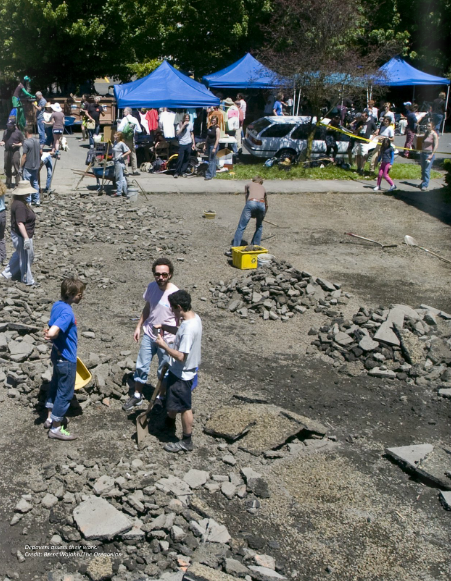
Depavers at work. Credit: Brent Wojohn/The Oregonian.


Idea #24: Depave

Depaving is the physical removal of asphalt or concrete surfaces. This is meant to reduce storm water pollution and increase the amount of land available for habitat restoration, urban farming, tree planting, native vegetation, and social gathering. Depave started as an unsanctioned, self-organized neighborhood effort in 2007, and since has grown into an officially recognized and supportive method. School yards, community gardens, food forests, and pocket parks are just a few of the areas created as a result. Millions of gallons of stormwater runoff have been diverted and stronger ties built between neighbors and the place that they live.

The official Depave website may be viewed here: http://depave.org/.


A great example of de-paving and creating a rain garden can be seen in this video from San Antonio with Better Block founder Jason Roberts.

Better Block Middlesborough was held from October 25-27, 2013, in Middlesborough, Kentucky. To help with planning for future events like this, please consider making a donation today!

Managing the Event

Wednesday, October 2, 2013

30 Ideas in 30 Days: #25 Pop-up Cafe

30 Ideas in 30 Days

In our last post we talked about Parklets. That is only the start when it comes to creating walkable urbanism in downtown areas. We'll next focus on a variation of Parklets called Pop-Up Cafes.


Pop-up cafe in Dayton's Bluff. Credit: Youtube.


Idea #25: Pop-Up Cafes

These ventures promote public seating in the parking lane and promote local businesses. These are particularly needed in areas where outdoor public seating is limited. These serve as placeholders for a time until sidewalks can be permanently extended.

Pop-up cafes provide valuable seating where there is none. Credit DNAInfo.com.

Better Block Middlesborough was held from October 25-27, 2013, in Middlesborough, Kentucky. To help with planning for future events like this, please consider making a donation today!

Managing the Event

Tuesday, October 1, 2013

30 Ideas in 30 Days: #26 Pavement to Parks (Parklets)

30 Ideas in 30 Days

In our last post we talked about the work of the National Complete Streets Coalition. Now we'll get into some specific tactics that might help to bring Complete Streets about.


Idea #26: Pavement to Parks (Parklets)

This approach at its essence is meant to reclaim underutilized asphalt as public space without large capital expenditure. Some of the techniques such as adding movable tables and chairs, painting asphalt, and the installation of inexpensive planters and re-purposed stone blocks, helps to increase the amount of public space available. In places like New York and San Francisco, these parklets have been a great success. The space created serves as a sort of laboratory, showing what might be possible if temporary improvements became more permanent.

Most parklets rest on a platform that sits level with the sidewalk. Materials are temporary and the design flexible enough that changes may be made during the trial period. Seating and greenery help to make the parklets welcoming and attractive. Occasionally space is provided for bicycle parking, or an outdoor dining area created for nearby restaurants and cafes. Costs are often assumed by a business or several businesses that recognize the ability to attract customers. Whether publicly or privately sponsored, parklets are considered part of the public realm and areas that may be freely used by the public at large.

Vancouver, BC's "Parallel Park." Credit: Facebook user.
Better Block Middlesborough was held from October 25-27, 2013, in Middlesborough, Kentucky. To help with planning for future events like this, please consider making a donation today!

Managing the Event